
February 2026 Rules Quiz Review
by Josh Cooper
As a best practice, export the test into a local document (Word, Google Doc, etc.) so you have an offline copy. As you work through each question, note both the correct answer and a rule citation or page reference so you remember why you chose it. This will also help you better process the rulebook.
If you hit a wall on a question, don’t get stuck — move on and come back later. If you still can’t find the answer, reach out to anyone on the Rules Committee (Bob, Mel, Josh, or Matt), or join one of our upcoming Office Hours.
The Rules Committee will be hosting virtual Office Hours to help guide you through rulebook logic and interpretation:
One of the defining traits of a quality umpire is not simply rules knowledge — it is the continual refinement of judgment. Rules quizzes are valuable not because they test memory, but because they reveal how we think. The goal of this review is to highlight a few of the most-missed questions from our quizzes and move beyond answers into understanding, interpretation, and application on the field.
There is both an art and a science to umpiring. The science is knowing the rules; the art is knowing how to apply them. You cannot succeed with only one — you need both.
Being labeled a “rules guy” can mean very different things. Sometimes it carries a negative connotation: the umpire who inserts an obscure ruling into a routine situation just to demonstrate knowledge. But there is also the rules guy every crew member wants — the umpire who can see a play, process the rules correctly, and apply them in a way that keeps everyone out of trouble. That is the official we should all strive to be.
Many incorrect answers this month did not come from ignorance of the rulebook, but from blending rulebook language with baseball vernacular and instinctive reactions. Our responsibility is to slow the game down mentally, even when it speeds up physically.
So, let’s get into the questions!
The Scenario: A pitcher may turn the shoulders to check runners while in contact with the pitcher’s plate, while in the:
The Ruling: Set position.
The Result:
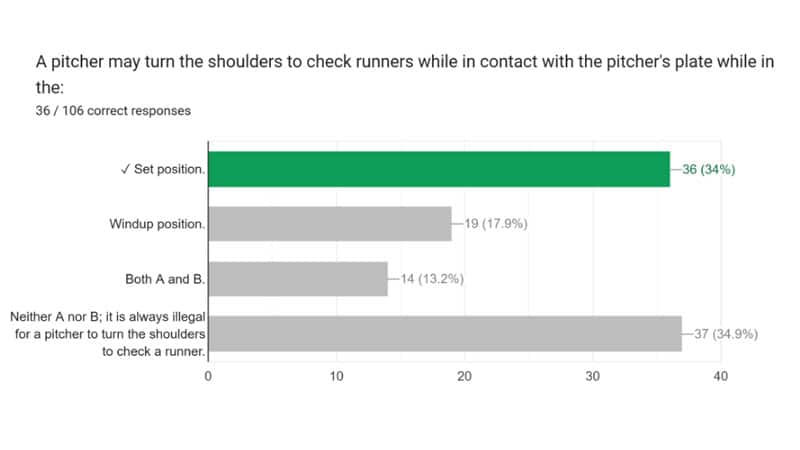
Commentary: This was the most frequently missed question. A large percentage of umpires believe any shoulder turn is illegal. The rule is more precise than that — and precision matters.
The confusion often comes from the phrase we hear constantly on the fields: “after he comes set.” In casual baseball language, that phrase means the pitcher has paused. In rules language, however, several distinct phases exist:
- Set position — determined by the position of the pitcher’s feet
- Stretch — preparatory movements before the stop
- The stop — hands together with a discernible pause
- Delivery
A shoulder turn is legal while the pitcher is engaged and preparing from the set position. Once the hands come together and the pitcher establishes the stop, he has committed to the delivery phase. At that point, a shoulder turn simulates a pitching motion without delivering the ball — the definition of a balk.
This is a classic example of why umpires must separate baseball talk from rulebook language. We officiate the latter.
The Scenario: If any situation arises that could lead to an appeal by the defense on the last play of the game, the appeal must be made:
The Ruling: While an umpire is on the field.
The Result:
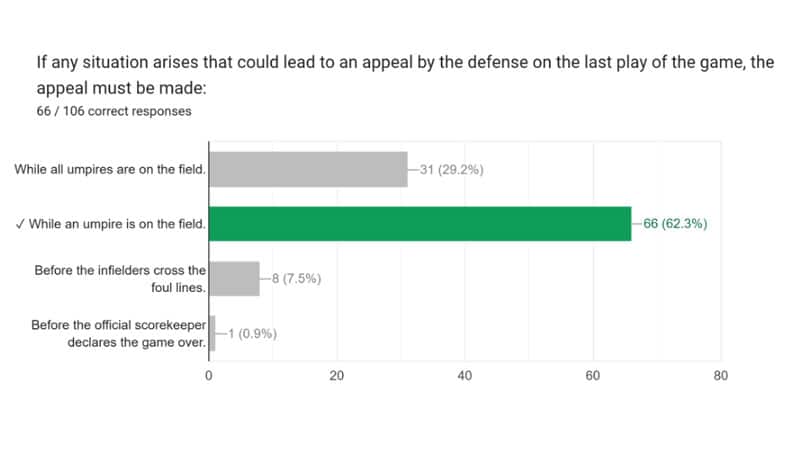
Commentary: Over a third selected “while all umpires are on the field.” The distinction is important because it directly affects crew mechanics.
Jurisdiction does not end when the game ends — it ends when the umpires, all the umpires, leave the field. That means:
- If one umpire leaves early, the remaining umpire inherits responsibility
- If one umpire lingers, the crew still has jurisdiction
- If an appeal occurs, you’re on your own
This is why crews must leave the field together and with purpose. Professionalism is not just appearance — it protects your partner. You shouldn’t sprint off, nor should you linger in conversations. A quiet, unified exit ends the game cleanly and removes unnecessary risk.
The Scenario:To start a game, the determination of whether the grounds and other conditions are suitable is made by:
The Ruling: The home coach.
The Result:
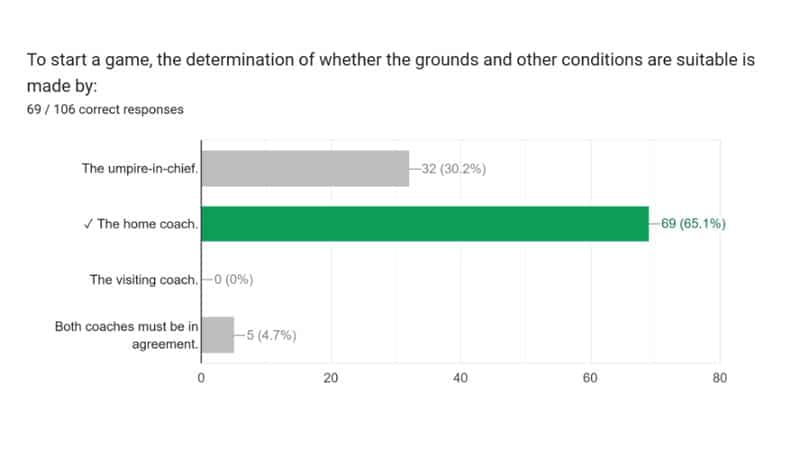
Commentary: Nearly one-third incorrectly chose the umpire-in-chief. This misunderstanding is common because we associate umpires with authority — but the rulebook intentionally delays that authority.
Before the first pitch, the game does not yet belong to us.
Once play begins, the umpires control suspension and resumption of the game. But prior to that, the home coach is responsible for field conditions.
Strong umpires handle this before the first pitch. If field conditions are questionable, discuss it with the coach ahead of time. Starting a game only to suspend it moments later is usually avoidable and can hurt credibility. Clear pregame communication eliminates most of these situations.
The Scenario:How many baseballs are required to start an NFHS baseball game?
The Ruling: 3
The Result:
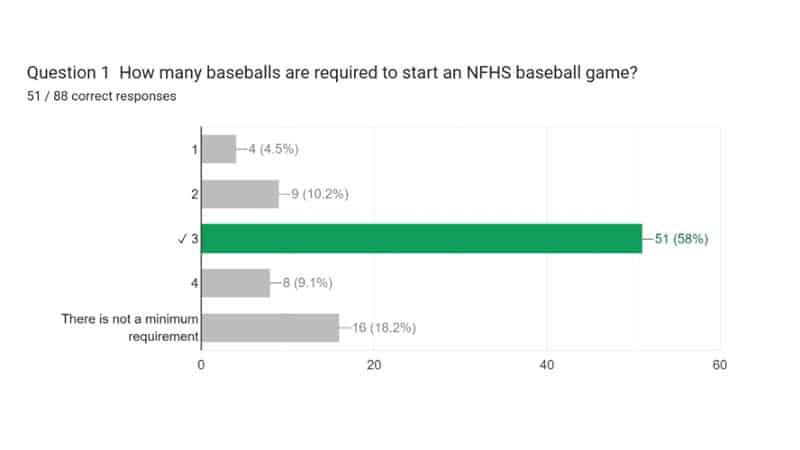
Commentary: This is a small pregame item, but it contributes to the overall professionalism of the game. “Umpire-approved” means more than just accepting what is handed to you — verify that each ball carries the NFHS authenticating mark and is in playable condition.
The rule does not require brand-new baseballs. In fact, a mix of new and quality used balls is ideal. If a coach hands you only a couple of new ones, ask for several gently used, game-ready baseballs as well.
Develop a routine: keep at least two baseballs in your bag at all times, and request more before you run low. Running out of baseballs unnecessarily stops the game and makes you look unprepared. Handled properly, this simple interaction also becomes a natural way to communicate with coaches and build rapport before issues arise.
When you get down to two baseballs in your bag, “Hey Chris, can I get four baseballs please?” is a lot smoother than “LAST BALL IN PLAY!” when you give the catcher your last baseball. This is a subtle way you can control the game and shows your game management skills.
The Scenario:A starting player, who has been removed from the game once, accidentally re-enters in the wrong position in the batting order. He is considered to be:
The Ruling: An illegal substitute.
The Result:
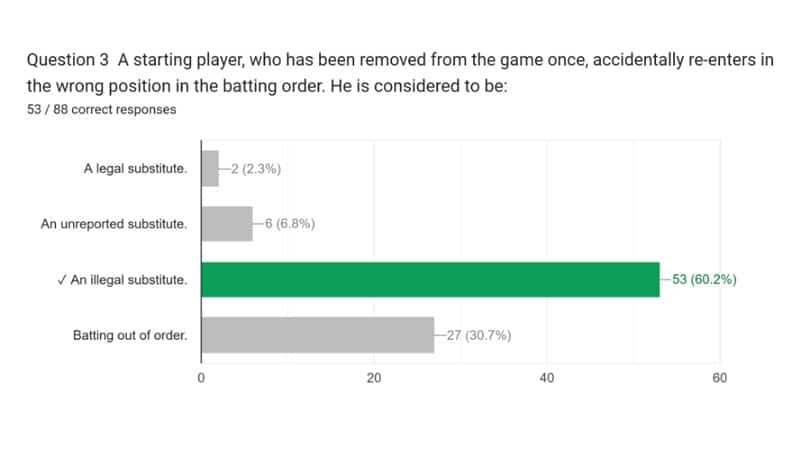
Commentary: This question highlighted a common misconception. The starter in this play does retain re-entry eligibility — he simply cannot re-enter in a different spot in the batting order.
Batting out of order is a sequencing mistake by a legal player. If discovered before the at-bat is completed, the proper batter replaces him and assumes the existing ball-and-strike count with no penalty.
Illegal substitution, however, is an improper entry into the game. A re-entering starter must return to his original lineup position — always. No legal combination of substitutions can change the batting order.
Why this matters: the penalties are significantly different. Under Rule 3-1-1, when an illegal substitute on offense is discovered, the player is declared out and restricted to the bench/dugout for the remainder of the game. Batting out of order, at worst, results in an out — and if caught during the at-bat, it may carry no penalty at all beyond correcting the batter.
The Scenario: R1, no outs, 3-2 count. The batter swings, and the pitch goes directly back, hits the catcher’s chest protector, and is then caught in his glove. R1, stealing on the pitch, arrives safely at second.
The Ruling:This is a foul ball. The count remains 3-2, and R1 is returned to first base.
The Result:
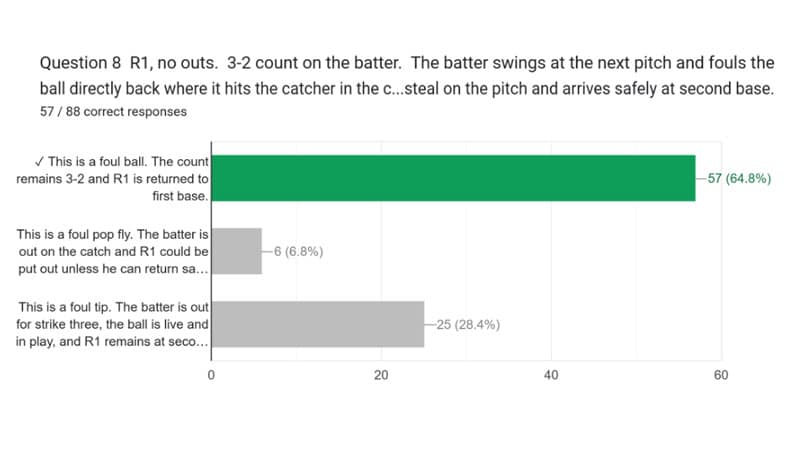
Rationale: Rule 2-16-2 states, “A foul tip is a batted ball that goes directly to the catcher’s hands and is legally caught by the catcher. It is a strike, and the ball is in play.”
Commentary: For a batted ball to be a foul tip — and therefore a live ball — it must travel sharply and directly from the bat to the catcher’s hand or glove and be legally secured. In this play, the ball struck the catcher’s chest protector before being caught, so it cannot be a foul tip. It is simply a foul ball, and the ball becomes dead immediately with runners returned.
This is an area where umpires often get tripped up because other rule codes treat similar contact differently. NFHS language is very specific: the ball must go directly to the hand or glove. Any contact with the mask, body, chest protector, or any other equipment first automatically makes it a foul ball, regardless of how quickly the catcher secures it afterward.
The reverse situation helps clarify the standard. If the pitch nicks the catcher’s glove or hand first and then pops into the air before he secures it — as long as it does not touch the ground, the batter, the umpire, or any other object — it is still a foul tip and remains live. With two strikes, the batter would be out, and runners may advance at their own risk.
The practical takeaway: when judging a possible foul tip, focus on the first point of contact. Hand or glove first equals live ball; anything else first equals dead ball.
The Scenario: (this video–click to view) R2, R3. On a ground ball hit to the second baseman, R3 is attempting to score. The second baseman throws the ball to the catcher, who chases R3 back to third base. The catcher throws the ball to the third baseman. R3 initiates contact with the catcher on his way to the plate. The third baseman throws the ball to the pitcher at home plate, who tags R3 out.
The Ruling: This is interference. Immediate dead ball, R3 is out, BR is awarded 1st base, other runners return.
The Result:
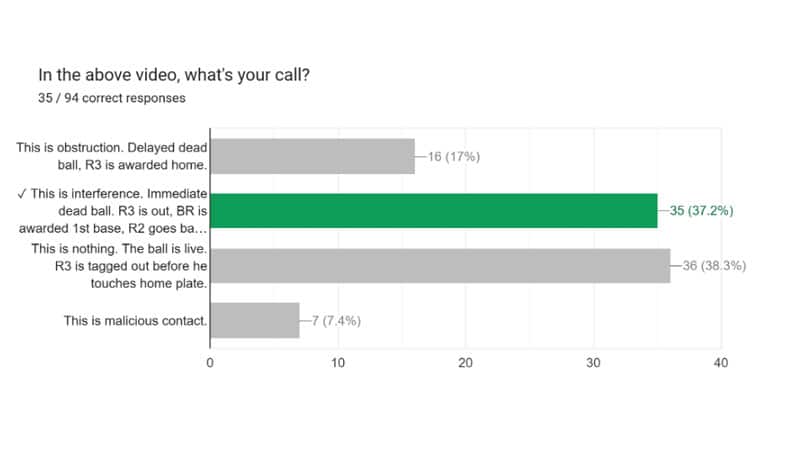
You could argue the runner may not have exceeded the three-foot allowance — it is close — and you could also argue the catcher was not making an immediate play at that exact moment, but possibly a subsequent one. However, rules must be applied with their intent in mind. When the runner’s actions affect the defense’s opportunity, fair play and common sense guide the ruling. The contact may not have been malicious, but it appears deliberate, and it altered the play.
Calling this “nothing” would still produce an out at the plate, but it effectively excuses the offensive action and signals that the behavior is acceptable. Our rulings should address not only the play’s outcome, but also the legality of the actions that produced it.
Commentary: I won’t repeat the thoughts shared in the answer key by Brian deBrauwere or Patrick Faerber — their interpretations are sound and worth internalizing. Instead, this play is a good opportunity to talk about process.
This is the difference between
Contact by itself does not decide obstruction or interference. We have to evaluate responsibility and effect. Ask yourself:
- Was the fielder in the runner’s legitimate path to a base?
- Did the runner’s actions hinder or alter the defense’s ability to make a play?
In a rundown situation, it is rare to have contact without obstruction or interference. If we rule this is not interference because the runner’s actions didn’t “stop the play,” then we have to ask: where is the line? How many fielders may a runner contact before it becomes a violation? At what point does the defense’s opportunity become unfairly affected?
Intent is not the deciding factor — impact is. Even without malicious contact, the runner changed the defense’s opportunity to complete a play. By rule and by philosophy, that is interference.
An important officiating principle applies:
What we permit, we promote.
If we consistently treat this as incidental, it will continue to happen. Players quickly learn the standard we establish. Our job is not only to rule on the immediate play, but also to preserve competitive fairness for the remainder of the game.
Mentally slow the play down:
- See the entire action
- Identify the defense’s opportunity
- Evaluate the runner’s responsibility
- Then make your decision
Strong umpires don’t guess fast — they judge based on the rules, with help from common sense and fair play.
We hope this enhanced review has been helpful. Keep studying, keep asking questions, and keep striving to be the best umpire you can be.
Until next time.
The Blue Crew News Team
Table of Contents
Vol 2 Issue #2 – Feb 23, 2026
Letters to the editors welcome at [email protected]
MACNV Association Meeting: Mar 1, 2026
Replay of the MAC-NV Association Meeting via Zoom on Sunday, March 1, 2026
MACNV Association Meeting: Feb 2, 2026
Replay of the MAC-NV Association Meeting via Zoom on Monday, February 2, 2026
MACNV Association Meeting: May 18, 2025
Replay of the MAC-NV Association Meeting via Zoom on Sunday, May 18, 2025