

A New Look At First Base
by Bob Nasser, NVBUA Rules Interpreter
This month’s edition of the rules focuses on the pending NFHS change at first base for the 2027 high school baseball season. I have received word from VHSL that a decision will be made and be uniform across the state as to whether the double first base or the 18” base (MLB dimensions) will be used. I have not heard anything from Maryland and will keep you updated there as that information becomes available. I am told we are starting to see double first bases show up on fields in Loudoun County, Virginia. My opinion is that if we arrive at a field and there is a double first base, we should use it, as it is a safety measure and if we ignore a safety measure, we could potentially open ourselves up to liability. So let me review the basics of the double first base.
First, the double first base exists only when there is an initial play at first base. The runner must touch the colored base and the fielder the white base. If on a play at first base, the runner touches the white base and does not have two feet on the ground beyond the base, by rule, the runner is out. However, if the runner beats the throw, with two feet on the ground beyond the base, but touches the white base, again, by rule it is considered a missed base, the runner is safe, and can be put out by an unmistakable appeal prior to returning to the base.
In NHFS, there is one exception to this rule, which is that on a dropped third strike, either player (the runner or F3) can touch either base, to avoid a collision. College umpires will note that the NCAA has a second exception, for throws that pull the fielder into foul territory, the runner may touch the white base to avoid a collision (the fielder still may only touch the white base in this circumstance). NHFS does not have the second exception.
Once the runner reaches first base safely, the colored base disappears and is no longer relevant. If the runner rounds first and returns to first, the runner must touch the white base.
Another point of emphasis is when the runner beats out an infield hit and overruns first base. The colored base is no longer relevant. If the runner is returning to first and has not yet touched the white base, and is on the orange base, this would be nothing. They are just returning to the base after overrunning the base. However, if the runner touches the white base and then steps off onto the orange base, as happened in one of my Potomac League games this summer, the runner would be out if tagged.
Umpire Classroom (the YouTube channel) has a great video on this – and I encourage everyone to watch it
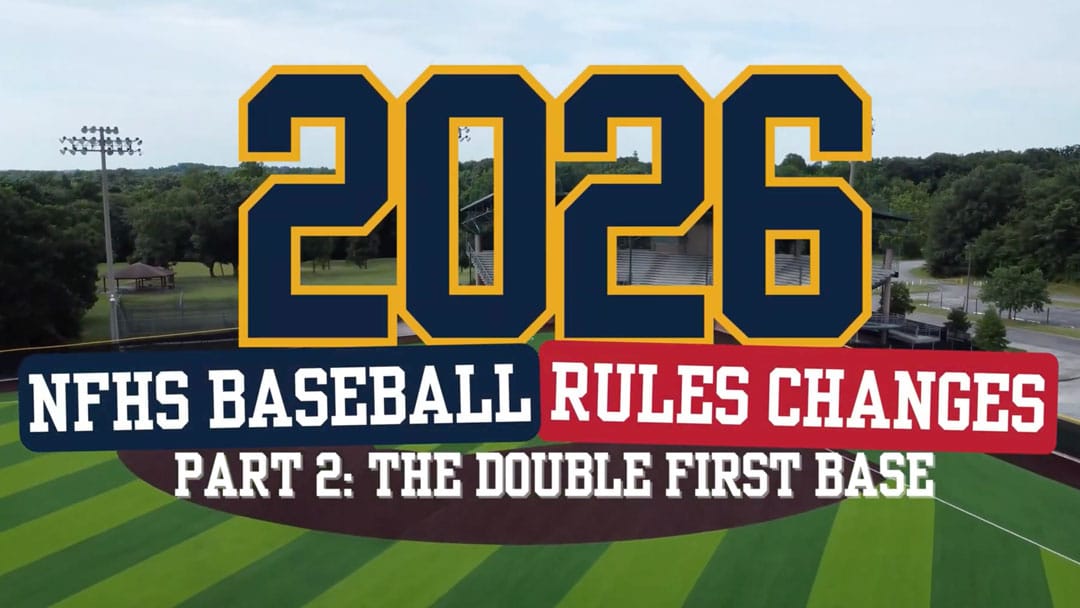
We will have much more information once VHSL and MPSSAA make a decision. I am told that Fairfax County plans to install double first bases at all county high schools. For now, please follow these guidelines if you arrive at a field with a double first base.
Bob Nasser [email protected]
Table of Contents
Vol 2 Issue #8 – August 31, 2026
Letters to the editors welcome at [email protected]
MACNV Association Meeting: September 27, 2026
Replay of the MAC-NV Association Meeting via Zoom on Sunday, September 27, 2026
MACNV Association Meeting: May 3, 2026
Replay of the MAC-NV Association Meeting via Zoom on Sunday, May 3, 2026
MACNV Association Meeting: Mar 1, 2026
Replay of the MAC-NV Association Meeting via Zoom on Sunday, March 1, 2026