Umpire Profile
John Porter
By Gary Reals
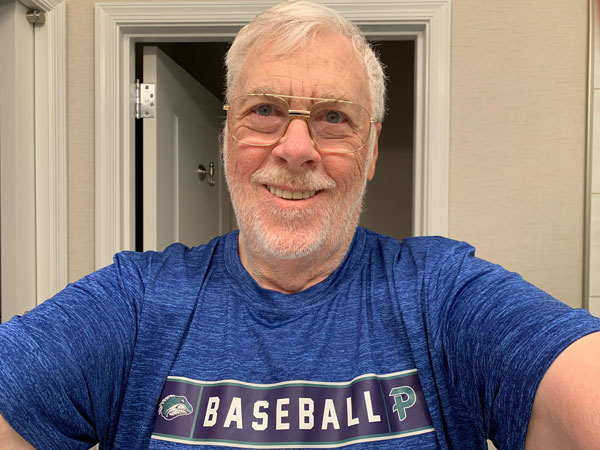
At the time John Porter was first selected to serve as Commissioner of NV Umpires in 1985, his predecessor had operated with a spiral notebook. Each day the hand-written list of all games was contained on one page: date, time, location and the names of the two umpires assigned to each game. On any given day in those years the total number of NV games was about 20 or less.
“I essentially said that’s bullshit!” recalls John. In what probably was his first big decision as Commissioner, Porter went digital, or perhaps we should say pre-digital. He got a computer and built a database on what was then a precursor to Excel. When he took over in the mid-80’s, NVBUA served a total of about 25 high schools, 3 colleges and roughly 75 umpires.
“Originally, it was not my intention to grow the association,” says Porter. And Blues, that is precisely when NVBUA developed a new brand that has become its bright shining star: training, rating and assigning. What had been a good-ole-boy network was about to become a hallmark of excellence. John puts it quite simply, “I made the best umpires, not the senior umpires, work the best games. And that proved to be the impetus for growth of the association.” Indeed! Ultimately and unmistakably, NVBUA got bigger because it got better.
Fast forward 40 years, and John’s financial guru Chris Williams manages the business side of our association, wheeling and dealing with “multiple hundreds” of leagues, clients, high school systems, collegiate leagues, and regional tournament groups…not to mention all of us poor umpires 😢. Chris regards the Commissioner as an “extraordinary man who is fair and caring and extremely principled. He loves teaching and training people.”
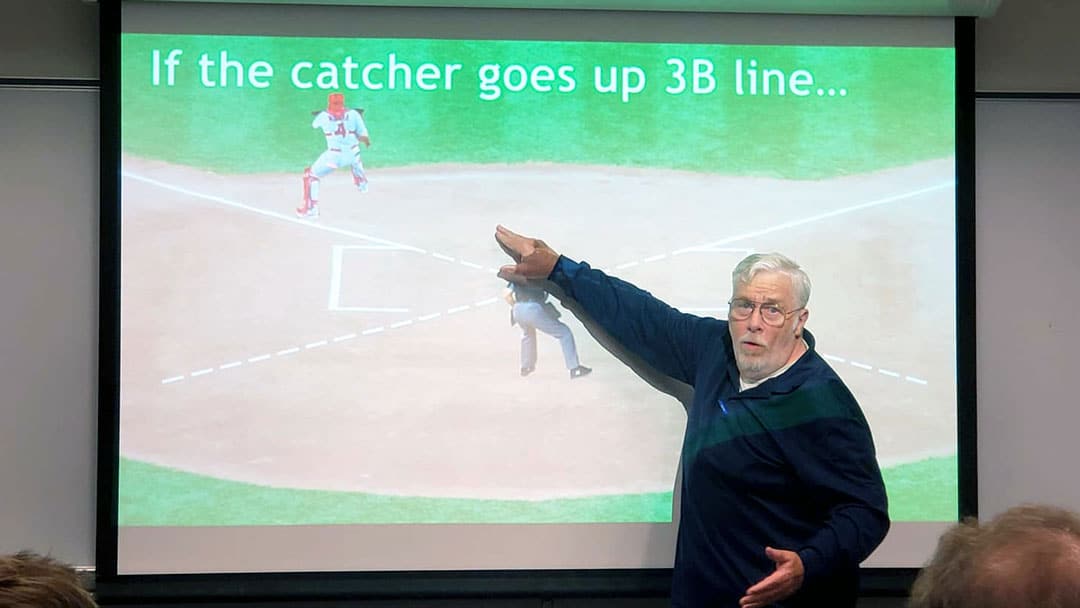
To understand the rise of John Porter, we must go back in time. After graduating from Falls Church High School, John didn’t know which way to turn… college or something else. In those early years, however, he was “super patriotic plus a lover of history.” Not surprisingly, young John felt the tug and joined the US Army, “I was gung ho! I thought I was going to be a lifer.” But, as a young enlisted infantryman, Porter wasn’t at all satisfied. He wanted more, took the initiative and quickly applied for OCS. John steamrolled through training at Ft. Benning and became a 2nd Lt. During assignment and field training in Panama, he quickly rose to Platoon Leader and soon after that, promotion to Captain. Needless to say, in those years, a fast-rising, kick-ass young officer didn’t remain in Panama for very long. In 1969, Porter was moved to Vietnam where the “idiots wanted to put me on the administrative staff of the Battalion.” In the infantry, Captain is a rank widely coveted because a Captain commands an entire company. No surprise, John Porter regarded himself “a hot potato always wanting to do the big job.”
Well, Blues, sad to say, it didn’t take long. On a mission in the Central Highlands in 1970, Porter’s four platoons were ambushed. Riding along a jungle trail in an armored carrier at the front of his procession, Capt. Porter was talking to an airborne observer trying desperately to get some support for another company as well as his own. John was hit by a rocket grenade nearly destroying his lower right leg. He was medevacked to Danang, then Tokyo and ultimately to Walter Reed Hospital here in Washington where he lived for the next 2 years. Amputation of his leg was narrowly avoided, but he underwent countless surgeries having his leg re-built below the knee. Porter’s foot and ankle were fused with bone from his hip.
In the 1970’s, PTSD wasn’t even known. Fifty-five years later it is well known of course and John receives counselling to this day. But when he left Walter Reed and the Army in 1972, “I was broken and I couldn’t function. I couldn’t keep a job. I couldn’t do anything.” Porter was still unaware, or in denial, that he was suffering from PTSD. “I tried to get employment and I couldn’t do it. I was too proud and too macho to see it.” As his physical recovery progressed, John’s adrenalin fixes came in the form of white water canoeing and skiing some of the most difficult mountains around.
What he could not have foreseen was the transition that was about to take hold and get his life back on track. Wife Janet, who married him right after he enlisted in the Army, was a teacher at Westlawn Elementary School in West Falls Church. In her 3rd grade class, Janet had a troubled youngster whom we‘ll name Jim Doe. His dad was in prison and one day Jimmy came to school with a gun. John naturally became alarmed for Janet’s safety but also for Jimmy’s mother. He says, “I saw a problem. I took the initiative. I got involved. I met with his mom and asked if I could help.” What followed… John Porter “became that little kid’s big brother.”
Blues, the headline: Jim Doe “was a pretty good athlete.” Among an array of activities, John signed him up for Falls Church Little League. And that’s when John Porter became a coach as well as a trainer…Jimmy’s coach. John & Jimmy ended up winning 4 championships in 5 years.
And while the resurrection of Jimmy was taking place in 1977, another lad came along into this world by the name of Rob Porter. “When he was born, I stopped being a kid and I became a grown-up,“ says his loving Dad. Finally, “it gave me direction, a pathway and a purpose.” A second resurrection was underway!
Together, working with Jimmy and then fathering Rob, as well as daughter Jamie who came along a decade later, John Porter slowly and steadily became imbued with a deep “sense of value and worth.” And young Porters became the grateful beneficiary of their father’s love and attention. “He’s always been 100% supportive. I didn’t know it at the time, but as I got older I’ve become more and more appreciative,” says Rob…who’s named after his grandfather who was “my Dad’s hero.”
In the mid to late 1970’s Porter was coaching Falls Church Little League baseball and lending a hand to help the local umpire association because “they needed help.” Finally, he was asked by league officials to umpire their AAA Little League championship. And Blues, that is when Porter saw the light! Perhaps, we should call it “The Blue Light Special!”
It was in 1979, John Porter was so disgruntled with the state of local umpiring, which he deemed “so crappy” he launched his own suburban umpire association. He explains, “a true part of my DNA is to help people.”
Just a few years later, Porter found his way to NVBUA. In short order, he landed on the Executive Committee. And then at the annual meeting in 1985, the question arose, kind of like that 800-pound gorilla in the room….who’s going to become our next Commissioner? Ronnie Rodriquez stood up and declared loudly “John Porter can do it!” Sitting in the back of the room, John “was not only not expecting it. I didn’t want it.” But as we all know and bask in, he got it! Big time!
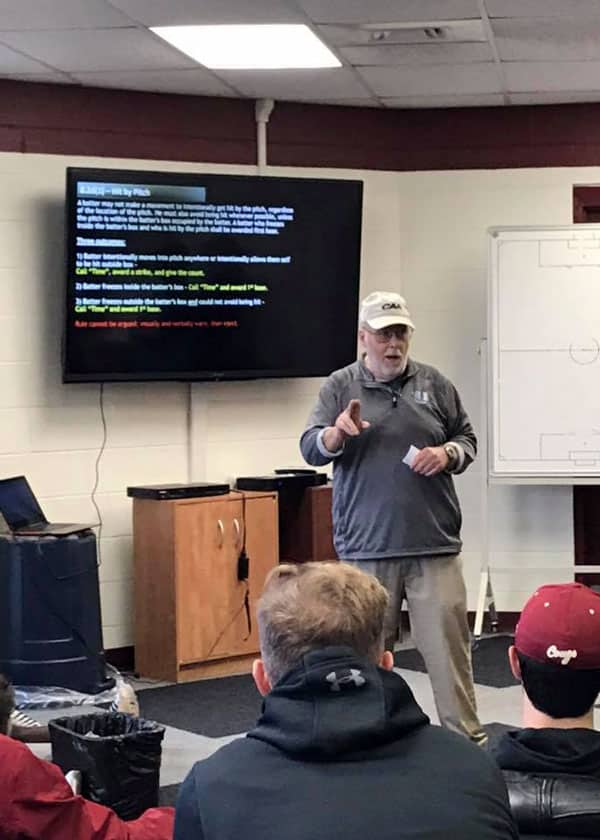
The new Commissioner became hyper-focused upon improvement in umpire training more than growth in the number of umpires. Naturally, one led to the other. Specifically, it led to one of John’s earliest recruits. Also, one of the all-time best. While watching some Babe Ruth games in the early 1980’s, Porter spotted a young military fellow by the name of Bob Gustin. For the next 30 years or so, Bob, who rose to Colonel in the U.S. Air Force, wistfully regards it as “the most fun I’ve ever had.” In short order, he recalls, “John asked if I’d wanna help in training. I said hell yeah! We evolved from training on a dry eraser board, to flip slides, and then the digital age brought amazing, computerized animation into play.” Gustin remained deeply involved in NV training for the next three decades.
Porter’s primary focus has always been on teaching and training…at all times of day and night. Young Rob, who began working games for Dad at age 13, recalls many evenings picking his brain about different situations at the dinner table. Another forum for Rob, often along with younger sister Jamie, was listening to Dad on the phone with umpires who often called late at night for clarification on questions that had arisen on the field earlier that night. “I learned so much from overhearing those conversations.” Fast forward a quarter-century, sonny-boy says Dad “still has the acuity and stamina to talk on the phone 24-7. He wants to talk. He still loves it!”
But truth be told, Blues, it wasn’t all work and training. For instance, there were those Friday night poker games back in the ‘80’s & ‘90’s. The regulars: Porter, Gustin, Rich Wolfe and Tim O’Toole, to name a few, found it, shall we say advantageous, to avoid working the plate in those early Saturday morning doubleheaders. “We kind of eased into those morning doubles,” recalls Gustin.
One of the younger guys, Craig Alden, distinctly remembers working those early mornings in the 1980’s and ‘90’s: “I always had to do the plate because they were hungover.” However, Craig is steadfast, “John Porter was always a trainer. One night a week, January til May, we’d go to Woodson HS and work off an old-school chalk board.”
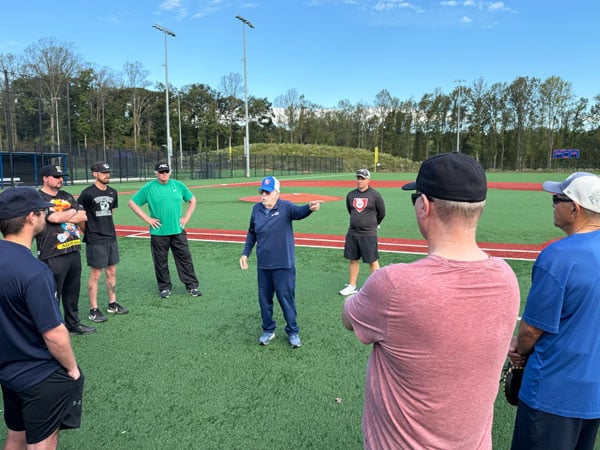
It was around the mid-1990’s that the umpiring landscape in Northern Virginia began to blossom big time. Porter became aware of Jim Evans and his Pro Baseball Umpire Academy in Florida. “He was revolutionizing the art of umpiring,” says John, “…exactly what we were trying to do up here in Northern Virginia.” Evans came up to NV and we “patterned ourselves from him and sent some of our umpires, such as Chris Segal, down to his camp in Florida.”
That relationship resulted in NV branching into MAC. “I started getting big into college baseball and ended up taking over county after county, slowly but surely.” Soon Porter was networking with other colleges and associations: Colonial, MEAC, CAA Conference as well as NCAA. “That’s when we changed and grew from being a little local association. All those leagues and associations wanted us because we were better than anyone else.”
Meanwhile, Rob Porter was working his way steadily up the ladder of baseball and umpiring. “Rob being born changed me and gave me incentive. He is one of the highlights of my life,” says Dad. The young man played youth baseball and was on the school team at WT Woodson, but he too eventually transitioned more to umpiring…imagine that. After high school, Rob was determined to attend only the best. “He was a very, very smart kid,” boasts John. Not only was Rob accepted to UVA, but earned his degree from its prestigious McIntire School of Commerce. Nevertheless, after all that education and lure of big business, Rob Porter still felt and followed the strong tug of umpiring. Blues, let us rejoice that he’s still with us today, year after year recruiting a new stable of very fine MAC umpires among several other duties, plus he currently works for MLB at Nats Park.
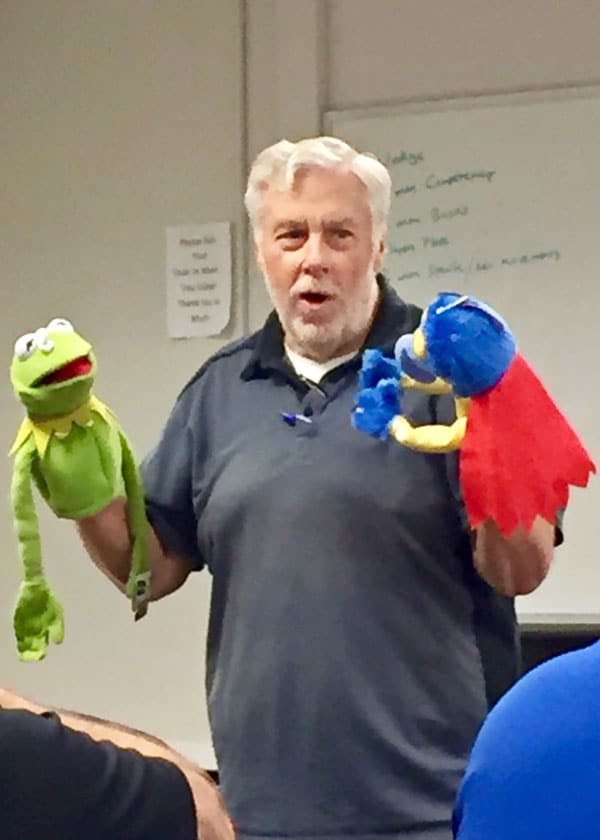
Here in 2025, John Porter’s next charge is to keep NV & MAC on the move. “We have to make our association keep running if and when my parachute doesn’t open and I’m not there anymore.” He says new leadership must keep chasing new deals, new contracts, new umpires and new technologies. As for the new digital zone coming to MLB in 2026, Porter confesses: “15 years ago I said it was bullshit! But in 2025 it’s a new world. It’s a natural progression. It had to happen.” Presently, MAC is the only local association utilizing Trackman to train its umpires on calling balls and strikes within a small fraction of an inch.
Association President Dave Maher says John Porter “is the reason this organization exists and its guys can be at their best.” Dave admits he and Porter have had some differences over the decades but they never bled over onto the field. “I am the umpire I am right now because of John Porter.” As for the future, Maher says, “As you look deep into this operation, the more comfortable it is. We’re going to be okay. We’re going to keep on going.”
Concerning his Dad, this from Rob Porter: “He is the number one person in the country teaching umpires to keep safe and out of danger. From the mid ‘70’s to the present. Dude, it’s bonkers!”
Blues, the last word comes from John Porter. His advice: “In order to be successful…make the people around you successful.” This old company commander insists after all this time it is still all about training and rewarding those trainers. “My legacy has been teaching people to take care of each other. If you go out and do that and then receive some kind of reward…I love that.”