
March 2026 Rules Quiz Roundup
by Josh Cooper
It’s been a really fun month of rules quizzes. We hope you enjoy this content as much as we enjoy creating it. We used your feedback to hit some of the most requested topics:
- Conferences
- Batter’s Interference
- Force Play Slide Rule
- Substitutions
- Designated Hitter
- Improper Batters
We’ve got a laundry list of themes and topics still to hit, so stay tuned and keep looking out for new quizzes! This month’s roundup covers the top 5 most missed questions from Quizzes 4-7.
In future quizzes, expect more open-ended, judgement type questions, and we’ll use this platform to go through them every month. It really showcases that plays are not always black and white, and everyone’s judgement is different. The best thing you can do is know the rules and use your mechanical fundamentals to get into the best position to see all the elements of a play.
By the time of this publication, the state exams will be closed and the high school season will be fully underway. If you have any funky plays or weird rules situations, send them in. If you can provide a video, that’s even better! There is no better training platform than learning from your own and others’ handling of situations. If everything went right all the time, we’d never learn what not to do!
A Quick Note: “By Rule” vs. “In My Judgement”
Using precise language with coaches is essential. Umpires often get into trouble by using phrases like “in my opinion” or by letting coaches talk themselves into circles. The more you talk, the more ammunition you give a coach. Using clear and concise rulebook language will keep you out of difficult situations.
There are two phrases you absolutely need in your umpiring toolkit.
- “By rule…” means you are applying a specific rule to a situation. First, explain what you saw, and then explain how the rule applies. It’s most effective when you and the coach agree on the facts of the play, and you can simply state, “Coach, by rule, this is the outcome.”
- “In my judgment…”is the phrase reserved for situations that rely entirely on your assessment as an umpire. A classic example is a close play at first base: “Coach, in my judgment, the first baseman had possession of the ball, with his foot on the bag, before the runner got there.”
Judgment calls, by their nature, are not arguable. Your authority to make these calls is earned through preparation and positioning. By using proper mechanics to get into the correct position, you give yourself the best possible view of a play’s critical elements. Sound judgment begins with a clear line of sight.
When you combine excellent positioning with a deep understanding of the rules, you become a pillar of credibility. You can confidently adjudicate the play, manage the situation, and remain the calm center even when the game gets chaotic.
Before diving into the quiz breakdowns, a final thought on our shared responsibility as stewards of this game. When you walk onto a baseball field, you represent not only yourself but this entire association. It’s a role that demands pride and dedication.
We should all have goals: short term (each game, each season) and long term (where do you want your umpiring journey to take you). Everyone’s goals and timelines are different, and the best we can do is to handle what’s in front of us. I carry a personal mission statement with me to every game, and I encourage each of you to find a similar principle that grounds and drives you.
Always go on the field with the objective to serve the game, and that by the end of the game you will have elevated your standing and impression left on the coaches, players, and fans by your professionalism, hustle, and knowledge.
Work hard, have fun, and have a great first month of the season!
The Ruling: This is NOT LEGAL in (a) and LEGAL in (b)
The Result:
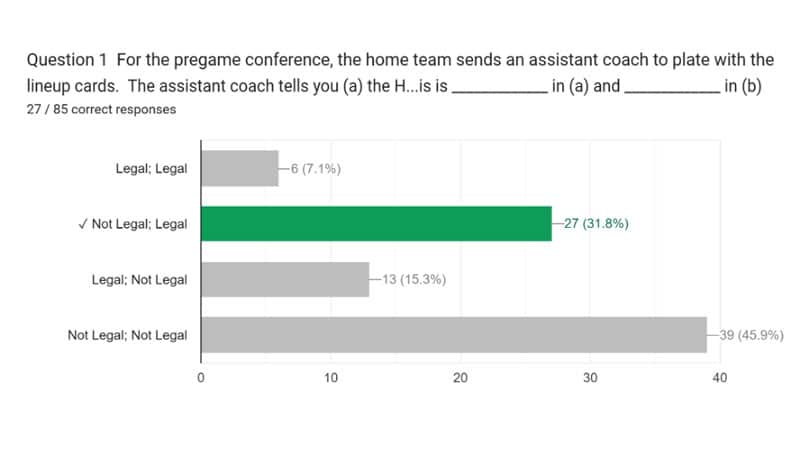
Rationale: Rule 3-2-4 states that the head coach MUST attend the pregame conference, if available. The if available is where it gets a little ambiguous. The case book (Case Plays 2-10-2 and 3-2-4 A, B, & C) give us a little clearer picture of what’s allowable.
In (a), running the bullpen is not a valid excuse to miss the plate conference. If the head coach refuses to attend, he will be restricted to the dugout for the game.
In (b), this would be a valid excuse to miss the plate conference, similarly if the Head Coach was stuck in traffic or on his way to the game. His administrative responsibilities to the school are a valid reason to be “not available.” The head coach is not restricted and will be able to resume his normal duties upon arrival.
Remember, NFHS baseball prioritizes safety and participation. If a head coach is fulfilling requirements for his role with the school, we shouldn’t penalize him or his team.
The Ruling: This is interference by the batter. R3 is out.
The Result:
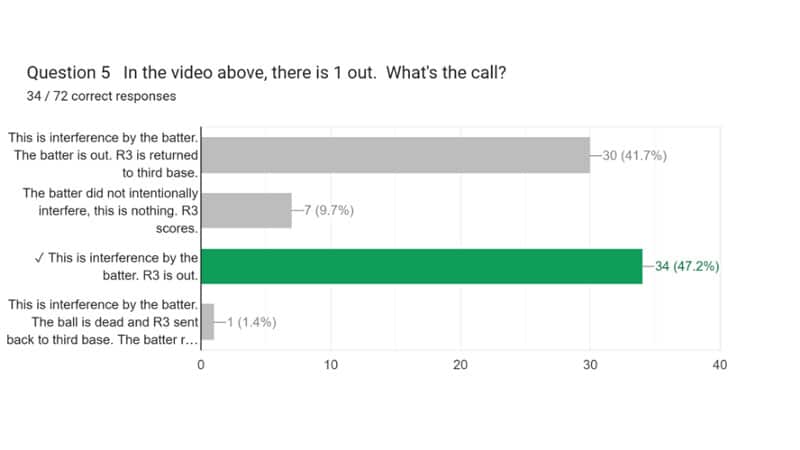
Rationale: Rule 7-3-5d states “A batter shall not interfere with the catcher’s fielding or throwing by failing to make a reasonable effort to vacate a congested area when there is a throw to home plate and there is time for the batter to move away.”
PENALTY: When there are two outs, the batter is out. When there are not two outs and the runner is advancing to home plate, if the runner is tagged out, the ball remains live and interference is ignored. Otherwise, the ball is dead and the runner is called out.
The reason R3 is out, and not in the batter in this case, is because we don’t want to give the offense a second chance at a run scoring play by sending R3 back to the third. If we send R3 back to third base and call the batter out, there are now 2 outs and the offense still has a runner at third base in scoring position. A stronger penalty, and by rule, you should rule R3 out and allow the batter to continue his at bat.
The coach requests and is granted “Time.” He tells the umpire that he’s sending in a courtesy runner, #21 Stevenson. Stevenson heads to first base to run for Ellis.
In the 3rd inning, Fox, the pitcher, hits a double.
The coach requests and is granted “Time.” He tells the umpire that he’s sending in the courtesy runner, Stevenson, to run for Fox at second base.
The Ruling: Stevenson can only run for Fox as a substitute, not as Courtesy Runner AND If the ball is put into play after Stevenson replaces Fox as a Courtesy Runner, Stevenson is an illegal substitute; he is declared out and is restricted to the bench/dugout for the remainder of the game.
The Result:
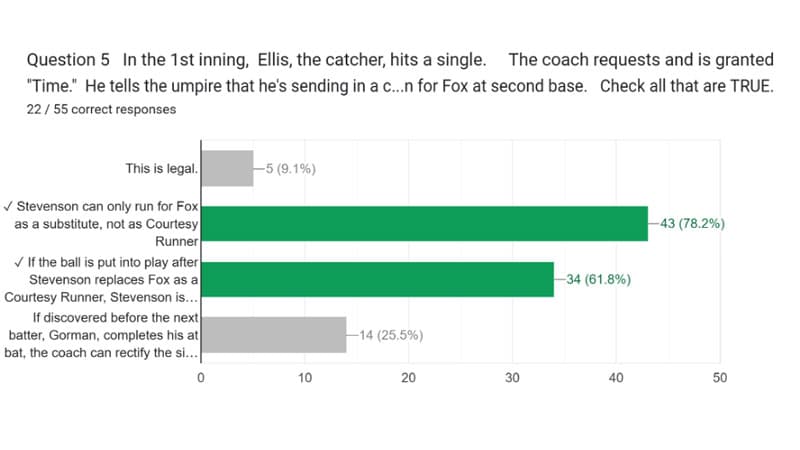
Preventative umpiring is key here. When a coach makes an announcement for a runner, take the extra 10 seconds to check your lineup card. If it’s the same runner that’s been running all day, it’s an easy check
If a coach sends a different runner out to CR, check the lineup card quickly to see if that runner is eligible. If he’s not, stop it right then. Poor awareness and game management would be the only reason an umpire allows this to get to an illegal substitution situation.
Yes, the coach SHOULD know the rule, but one of the guiding principles of NFHS baseball is participation, so we shouldn’t knowingly allow a coach to violate a rule that will result in a restriction.
The Scenario: Which of these are TRUE about an improper batter?
The Ruling: An improper batter is considered to be at bat as soon as the improper batter is in the batter’s box and the ball is live AND when the improper batter’s infraction is first discovered by either team, time may be requested and the improper batter replaced by the proper batter with the improper batter’s ball and strike count still in effect, provided the infraction is detected before the improper batter is put out or becomes a base runner.
The Result:
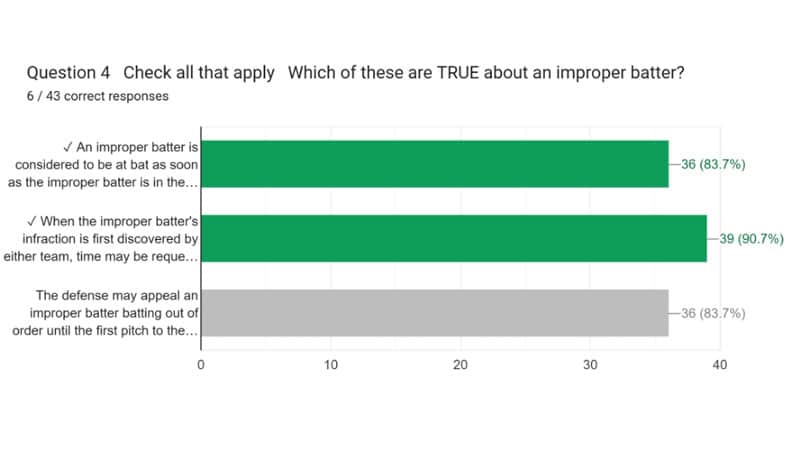
Rationale: Rule 7-1-1 states “… An improper batter is considered to be at bat as soon as the improper batter is in the batter’s box and the ball is live. When the improper batter’s infraction is first discovered by either team, time may be requested and the improper batter replaced by the proper batter with the improper batter’s ball and strike count still in effect, provided the infraction is detected before the improper batter is put out or becomes a base runner.”
Penalty 2 [summarized] says that the defense has until all infielders leave the diamond to appeal an improper batter.
For this question, many selected all three choices, but the rulebook tells us that for an improper batter, the defense has until the infielders leave the diamond to catch it.
It can be very tricky to distinguish the rule application between an improper batter and an illegal substitute. If you get into a situation like this, take your time, get together with your partner, and step through how to adjudicate.
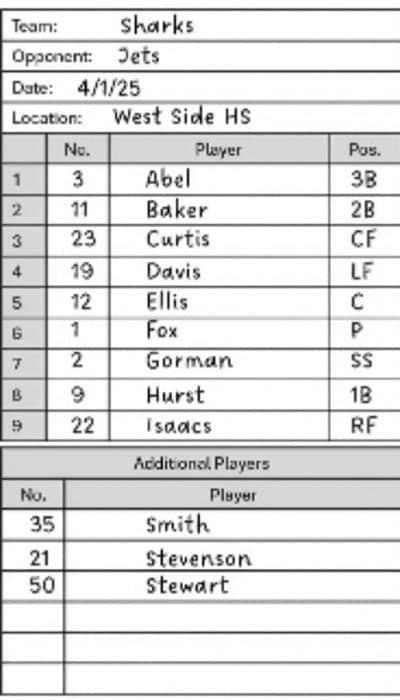
The Ruling: Rule Davis out, remove Baker from second base and bring Ellis up to bat.
The Result:
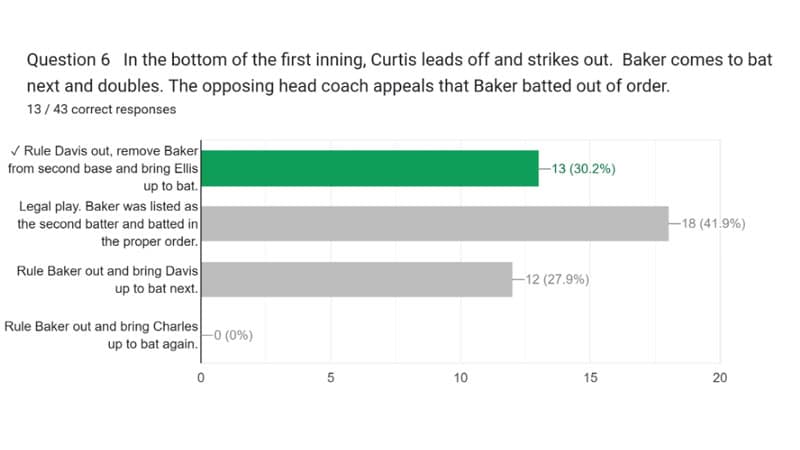
Rationale: 7-1-1 Penalty 3 states “When an improper batter becomes a runner and a legal pitch has been delivered to the batter … the improper batter becomes the proper batter and the results of the improper batter’s time at bat become legal.”
Abel was supposed to lead off, but Curtis batted instead. Curtis’ actions became legal once a pitch was delivered to the next batter. So effectively, Curtis is now the leadoff hitter, meaning that Davis bats next.
However, Baker batted instead. Baker hits a double and the defense appeals. Since Baker batted out of order (should have been Davis), Baker is ruled out, and Edward (who is listed after Davis) will come to bat.
This is another situation, that if you find yourself in, take time and get with your partner to step through what actually happened and then apply rules, awards, and penalties appropriately.
Table of Contents
Vol 2 Issue #3 – Mar 30, 2026
Letters to the editors welcome at [email protected]
MACNV Association Meeting: Mar 1, 2026
Replay of the MAC-NV Association Meeting via Zoom on Sunday, March 1, 2026
MACNV Association Meeting: Feb 2, 2026
Replay of the MAC-NV Association Meeting via Zoom on Monday, February 2, 2026
MACNV Association Meeting: May 18, 2025
Replay of the MAC-NV Association Meeting via Zoom on Sunday, May 18, 2025